Thursday, November 27, 2008

dale y dale y dale bulla dale!


Sunday I went to my first South American futbol game. It was madness.

The teams:
We went to see a game between la Universidad de Chile (la U) vs. Cobrecoa (some team from far away). Clarification - the "University of Chile" team is not like a college team. They are just a club team that bears the university name (weird yes, but that is how it is done). So most of the clubs represent different regions of the country, but Santiago is so big that it has three teams:

1) La Universidad de Chile (La U)


La U is a competitive team. Not as good as Colo-Colo, but better than La Catolica. Their mascot (?) is an owl, or a "buho," and their fans are referred to as "el leon" (the lion - for the roaring noise they make) or "la bulla" (the ruckus).

2) La Universidad Catolica


Not many people care about La Catolica. They aren't as good as the other two teams and their jerseys aren't as fun. But they still deserve some love.

3) Colo-Colo (los indios)


Colo-Colo apparently has the best players. They are called "los indios" (the indians) apparently because that is their mascot. However, down here they sometimes call darker-skinned people "indios" so I think that has something to do with it too. They also have the crazy flaite (gangster) fans, who I was really hoping to hang out with for an afternoon; but alas, my time is running out down here and I had scheduling conflicts with the Colo-Colo games that remain. Tragic.

Whenever any of those three teams play each other, the neighborhood surrounding Estadio Nacional basically shuts down in preparation for an afternoon of all-out gang fights. Would have liked to have seen that. But I also value my life and my well-being...so it's probably better that I missed those games.

The game:

We walk in and got patted down by the police. The 5 or so girls who were at the stadium were directed to female police officers - probably a smart way to avoid sexual harassment claims. 

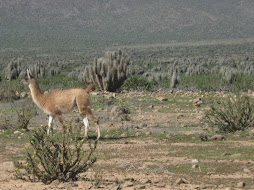
Then we were greated by more police (el paco). AKA - the G.I. Joes all geared out and carrying shields (not shown in this pic). The police know what to expect and these games and they come prepared. They have a team in the stadium on foot, a team surrounding the stadium on horseback and a team on the streets driving a tank called a "guanaco" (name for a llama-like animal) that spits "spicy" water at rowdy crowds. I don't know what spicy water means, but I don't think I want to find out.
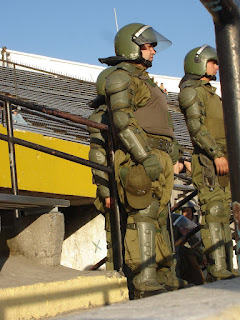

Then we went to our seats. We sat in the lame family section with all the kids and such because our overprotective chilean friends didn't want us to get hurt or get stuff stolen in the crowds. So instead, we just watched the crowds from far away (see in the distance).

Being far away had its perks. We could actually hear each other speak, so Daniel and Felipe educated us about all things futbol, including the millions of cheers and chants, such as "dale y dale y dale bulla dale" (which I think means something like "make lots of noise, crowd" or "let's get ready to rumble" or something of the sort.)
 We also had a direct view of all of the signs and such that the crowd held up, such as this sweet jersey:
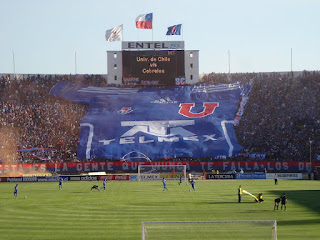


And these awesome fire torches (which were ocassionally thrown on the track, aiming for the policemen)


All in all, an adrenaline-filled event. Maybe one day I'll make it into the bulla. But I definitely won't go in there without a male companion.

Tuesday, November 25, 2008

Reverse culture shock

Last week, my program offered a workshop on "reverse culture shock" to prepare us for our transition back to the United States. Earlier in the semester, they had offered a workshop on culture shock, which I opted out of because, having been to South and Central America before, I wasn't feeling very shocked by anything. I wasn't planning to go to the reverse culture shock workshop either; however, my afternoon ended up being free so I decided just to go so that I could hang out with some of my program friends and enjoy the rare occassion of hearing one of our program directors speak in English (she's from Minnesota but ALWAYS talks in Spanish to encourage us to do the same).

Ulitmately, I'm very glad that I went to the workshop. I wasn't very surprised by the advice that we were given -- I'd felt most of the emotions before after coming home from college and after coming home from other experiences like Outward Bound and my trip to Argentina. 

Basically, they told us to prepare for the following:
  • Reverse culture shock will be harder than culture shock. Why? Well, we expect life to be so much easier back in a land where we understand what people are saying, where we can communicate without struggling, where we can feed our gastronomical/cultural/intellectual cravings. However, setting high expectations makes it more likely for us to be disappointed and/or frustrated with the land we return to. We might have idealized certain aspects of home and we might return with eyes that can only see flaws and room for improvement.
  • People change over 6 months' time. Thinking back to orientation week down here is an incredbly fuzzy memory. Thus, thinking back to friends and family back home is even fuzzier, and it will almost feel like a time warp going back to them. However, it won't be a time warp because they have changed and I have changed and we have to figure out a way to play catch-up on 6 months of life. But it's hard to explain the things that have changed about you emotionally and intellectually.  Returning home might lead to feelings of loneliness since few people can truly understand or appreciate the country or culture that we lived in and thus they might not understand why our world outlook has changed. And it's hard to come home to people who have changed in ways that you don't understand. 
  • The art of the elevator speech. Entreprenuers are told to prepare an elevator speech about their business proposals - a quick summary of their idea and it's potential that will be over before the listener's attention span wears out (30 seconds or so). The same goes for study abroad summaries -- people will politely ask "So how was your trip?" -- which might seem like an invitation to divulge the dozens and dozens of stories that you've accumulated in your time away; however, they honestly don't care that much. Thus, the returnee should think of some way to summarize the semester in a short and sweet way. If the listener then asks follow-up questions, then the returnee has the liberty to start going through some of his/her favorite anecdotes.  

  •  Avoiding the one-up game. This is primarily a concern for conversations between two people who just returned from different study abroad programs. Often, people come home super excited about their experiences and incredibly proud of their new "identity" and that excitement can often come off as competitive bragging. So when, say, a person who studied abroad in South Africa talks to someone who studied in Australia, the conversation might just start with sharing fun stories, but eventually it might turn into an all-out brawl between going on safari vs. SCUBA diving in the Great Barrier Reef. Quite a worthless argument considering both are amazing experiences and both have immense value to the people who experienced them. 
Although I understood most of these things already, it was good to have some time to think about the transition and it was comfroting to know that 47 other kids are going to be going through the same process as we go into next semester.

the real city that never sleeps

I'm not a party animal but I've tried to enjoy the Santiago nightlife as much as possible since I've been down here. These past few weekends have been especially busy with birthday parties (it seems like everyone was born in November!) and asados and goodbye dinners and such.

Now before coming down here, I considered myself quite a night owl. My normal bedtime is around 2AM and my peak energy hits around midnight or so. However, I am an considered early bird down here, wher people start going out to clubs around midnight and come home around 5 or so. Then, they often go back to a friend's house to talk before heading home to start the day (without sleeping!). I also learned that chilean wedding ceremonies don't start til 9PM , with the reception starting around midnight! I couldn't imagine my grandparents (or parents for that matter) making it through a night like that.

This weekend, I tried my hand at the chilean life. Friday night I went to our CIEE program goodbye dinner, which started at 8:30 and was held outside at a restaurant at the base of Cerro San Cristobal. The weather was perfect for an outdoor meal and the company was even more perfect :) Sad to say goodbye to my fellow CIEE classmates, but I'm sure that we will run into one another sometime in the future. After dinner was over, we watched a slideshow of pictures throughout the semester and then hit the dance floor to show off our cueca and salsa moves that we'd learned over the past few months.


Erin, me and Caitlin at the goodbye dinner :(

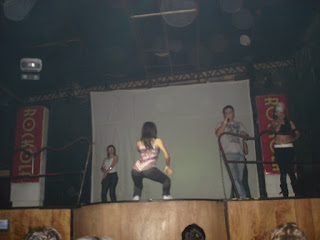
Left the goodbye dinner a bit early (12:30) to go to a birthday party at Rockola - a club in Barrio Bellavista. When we were entering, Marni's boyfriend got pulled aside for wearing white tennis shoes (apparently, those shoes are "flaite" - a style of attire that is not permitted at this club) Luckily he had an extra pair of shoes in his car so after waiting for him a few minutes we were good to go. Rocked, danced and sang the night away, pausing halfway through the night to watch a "dance" competition of single guys and girls in the club. I use the word "dance" lightly, because the performances were more focused on sexy stripteases and booty bouncings rather than artistic body movements. After the intermission, we proceeded to dance...enjoying the increased volume of salsa music in the later portion of the evening. By 4AM, we were pooped.

Oh dear...

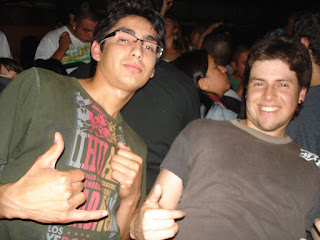
Rodrigo (my friend) and Felipe (Marni's boyfriend)

Headed home, smelling of smoke and sweat, but happy as a clam. Collapsed into bed for a few precious hours, thennnn woke up for another party!

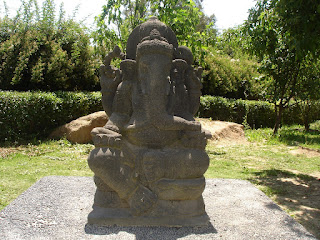
At noon, we headed to Pirque (about 45 minutes outside the city-- winery country) to go to my friend Paula's house for an asado (all day grill out). Her yard is absolutely amazing and will be elaborated on in later posts. However, one cool thing about it is that it used to be owned by a family from Indonesia, so they have Hindi sculptures all around, like this one of Ganesh:


Enjoyed a yummy lunch of meat and salads, went for a dip in the pool, chilled with Paula's zoo of pets (including adorable little baby kittens!) and chatted with some amazing people, such as the chicky below-->
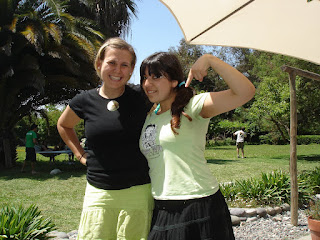
Me and Camila, in our opposites attract outfits :)

The asado ended around 7 PM, when people headed home to shower and get ready for one of our mutual friends' birthday parties. Unfortunately, I proved my gringaness by wimping out and heading home to relax. As much as I love a good party, I haven't quite built up the stamina for 3 in a row yet.

i want to live in America

The other night at my friend's birthday party, we got into a lively debate about "America." Chileans get pretty ticked off when gringos call themselves "Americans" to refer to the "United States of America" because South America is still part of America the dual-continent, but not part of the USA. Thus, chileans think it is arrogant for estadounidenses (people from the United States) to use the title "American" under the assumption that others will understand they are talking about the US.

In Spanish, it's easy to say "I'm a United States-ian" with the word "Estadounidense." In English, it's easier to just say "I'm American;" however, it's not much more difficult to say "I'm from the United States." However, even the latter presents challenges: my friend pointed out that there is also a United Mexican States that most people are unaware of; thus, we should clarify between the United States of America vs. the United States of Mexico. 

When you get down to the nitty gritty of it all, the argument seems kind of silly and it's hard to arrive at a good conclusion. But my curiousity led me on an investigation into which continent is the true America. Found some interesting tidbits to add to the confusion:

1) Say my name, say my name
Okay don't know about you, but I always learned that America was named after mapmakerAmerigo Vespucci who explored South America from 1499-1502. This is still a common consensus. However, BBC.com has informed me about another potential candidate for the "name that country" contest.  Apparently, some guy named Richard Amerike, a merchant who funded John Cabot's expedition to North America in 1497, might deserve the true claim to fame. It's argued that Amerike is the more likely namesake of the country because places were usually named after people's last names rather than their first names. (Hence, naming us after Amerigo would make our country Vespuccia or Vespucci Land or something like that).

2) Identity crisis
However, regardless of who we're named after, the North and South American continents probably shouldn't be named America at all. If our plan was to name our country after the first European explorer to arrive, we should probably be named Columba or something, since in fourteen-hundred ninety-two, it was in fact Columbus who sailed the ocean blue. 

If we decide that the true America is the place that was discovered first by Europeans, (presuming that Columbus was the first to arrive) then the place to receive that title of the "first" America would be not be mainland North OR South America; rather, the prize would go to the Bahamas - right smack dab in the middle of the two giant landmasses. According to wikipedia, the Bahamas are part of North America, so one could argue that Columbus landed in North America first. However, he then hit mainland South America before reaching mainland North America, so perhaps South America is the more American continent.

But really...Columbus wasn't the first guy to discover the Americas. There was a whole heap of indigenous tribe that beat him to that. So if we call those people "indians," perhaps we should really be named the Western Indies?
 
3) X marks the spot
However, if we are going to stick with the name America and just try to figure out where our name first started being used, we should look no farther than the Waldseemuller map (1507) --the earliest existing map using the label "America." The word is placed on South America, above present-day Chile and Argentina. So does this mean that South America is the "true"/"original"/"first" America?

Ay what a mess. Where to go from here? This guy proposes we change our name to the United States of North America. I say we just all try to proceed with caution about how we portray ourselves and how we interact with the rest of the world and we all just live as one big happy misnamed American family. Or we come up with some acronym using the first letters of all fifty states. 

Monday, November 24, 2008

the gringa card

In conversations with other American friends, one conclusion we've all come to is that we are going to miss using what we call "the gringa card." 

Although this magic "get out of jail free" pass can be used by gringos as well, it is most exploited by the ladies.

Here are some situations where the gringa card is used:
  • Class: some professors help out foreign exchange students by grading them easier or being more lenient with assignments and such. Unfortunately, I wasn't a recipient of this benefit.
  • Talking: if i say something out of place (which i often do in english), i can just blame it on the foreign language. and if i don't know how to say something correctly, I can just try to make it sound as cute as possible. just like adults admire and cheer when a baby speaks its first words, chileans gawk over gringas who try to imitate chilean accents or slang.Example: I always try to add "po" to the end of words because that's what the chileans do. However, everytime I do this, people comment on how cute I sound. I admit, I'm going to miss people thinking I'm adorable all the time.
  • Clubs/parties: just like girls usually get a free/discounted cover in the states, girls are also treated like royalty at clubs down here. Gringas get extra special treatment. This applies to just social events in general too...I've felt more social than ever before just because everyone wants to practice their english with me.
  • Mistakes: whenever I mess something up, I just alude to the fact that I'm a foreigner and generally all blame disappears.

school's out for the summer!

I'm freeee!! Wahoooo....

Thursday I finished with all of my exams and papers for the semester. Yay! Such a great change to be finished with the semester before Thanksgiving.

Although I enjoyed the content of most of my university classes and I am now a much faster reader and writer in spanish, I think I would have preferred to have spent all my time just working on my verbal skills instead. But such is life and such are college graduation requirements. Let's just hope that Penn accepts the credits that they said they would.

These next few posts are going to be a lot of count-downs/summaries. Here is the first:

Top 3 things I'm going to miss about school in Chile:

1) Cheap books
Much to my wallet's delight, I didn't purchase one single textbook this semester. Down here, books are absurdly overpriced. Thus, I textbooks are practially luxury items. Solution? Professors leave the texts on reserve in the library and then students go make photocopies of those texts. I'm not sure how legal this system is. In fact, I'm pretty sure it's about as legal as pirated movies and cds...however, that is the system and the money I saved on textbooks helped me rationalize the money I spent on trips and such throughout the semester. 

2) Always on time
Although I generally made it to my classes about 5-10 minutes after their official start time, I was never late. Professors generally stroll in about 10 minutes late. Chilean students come in 5 minutes later. Students who walk in late are never condemned by the professer and, in fact, are barely even noticed. This time lapse was quite a lifesaver, especially on those days when I woke up at 8AM for an 8:30 class (at a campus about 45 minutes from my house). 

3) Distance makes the heart grow fonder
All universities down here are commuter campuses. Therefore, when the school day is over, you actually leave campus and go home. While the endless hours of commuting to class were definitely exhausting, they were also a much needed blessing of time. I made sure to save my metro rides to and from school a sacred "me time" where I could read, relax to the sounds of my ipod or simply stare out the window and reflect. These metro rides separated my school life from my personal life...a nice change from living on a campus where it's hard to separate yourself from homework or people talking about their heaps homework or people stresing about talking about their homwork.
 

Top 4 things I'm not going to miss about school in Chile:

1) Public grades
Oh yes, privacy is just not something that Latin Americans pride themselves on. So why should they change their ways to keep a silly little number private? I think the purpose of publishing grades is to incentivize competition and encourage students to take personal pride in their work. Definitely a helpful tool down here, but I sure am glad we have privacy of our grades back at Penn...there's enough competition and obsession with grades up their as it is.

2) The library is now closing (but it's still light outside!!)
Since all students are commuters, the campuses actually shut down at night time! This means no 24 hour libraries. Boy did I miss Van Pelt this semester.

3) Callete huevon (hush ya'll!)
It's definitely not uncommon for students to talk during class. And not just whisper talk-- like have a lively loud conversation. Quite frustrating when I can barely understand the professor to begin with.

4) Madness
Return to my posts about class registration from the beginning of the semester for memories of this madness. Much different than the beautiful Penn InTouch registration system with all its organized majesty. Also, things have been a little inconvenient the past week or so because the maintenance workers throughout the university went on a salary strike. Nobody was there to work the printers or the library, so we had to made due with out them. Annoying, but it surprisingly unphased me this time...it's definitely going to be weird going back and not running into a weekly strike.

Monday, November 17, 2008

first goodbye

Although I should be studying away to cram in the modern political history of all of Latin America and to read about 200 pages on sustainable development, I need to celebrate making it through my religion class. I´m also done with mountaineering too. No more classes at Pontificia Universidad Catolica :( With about three weeks left before my flight home, this is my first in a long series of goodbyes I will have to say to all things Chile.

Today I took a final exam for my "Lo Femenino en Dios y el Ser Humano" class. We basically had to summarize the the entire semester´s worth of material into a three-page long essay. It was tough, but I felt prepared so hopefully it turned out okay. I´m sad that class is over because I really enjoyed the reading material and the professor-- even though she teaches at a fairly conservative Catholic university in a fairly conservative country, she has some pretty progressive views. And a surprising number of the Chilean students in the class have either an apathetic or a atheist view towards religion. It will be interesting to see how Chile´s religious leanings change as the years go on.

In other news, Chile was recently featured in the New York Times with yet another positive portrait of the country. Apparently, the public health system failed to notify about 2,000 carriers of H.I.V. that they were had the virus. The problem was due to disorganization and miscommunication between different partner organizations...can´t say that´s an uncommon problem down here. It´s just too bad that this mishap might cost a couple thousand lives.

Okay back to work.

un abrazo,

Lindsay